

There are these two young fish swimming along and they happen to meet an older fish swimming the other way, who nods at them and says “Morning, boys. How’s the water?” And the two young fish swim on for a bit, and then eventually one of them looks over at the other and goes “What the hell is water?” (David Foster Wallace, unfortunately a misogynist)
We’re not often encouraged to question the water one is swimming in.
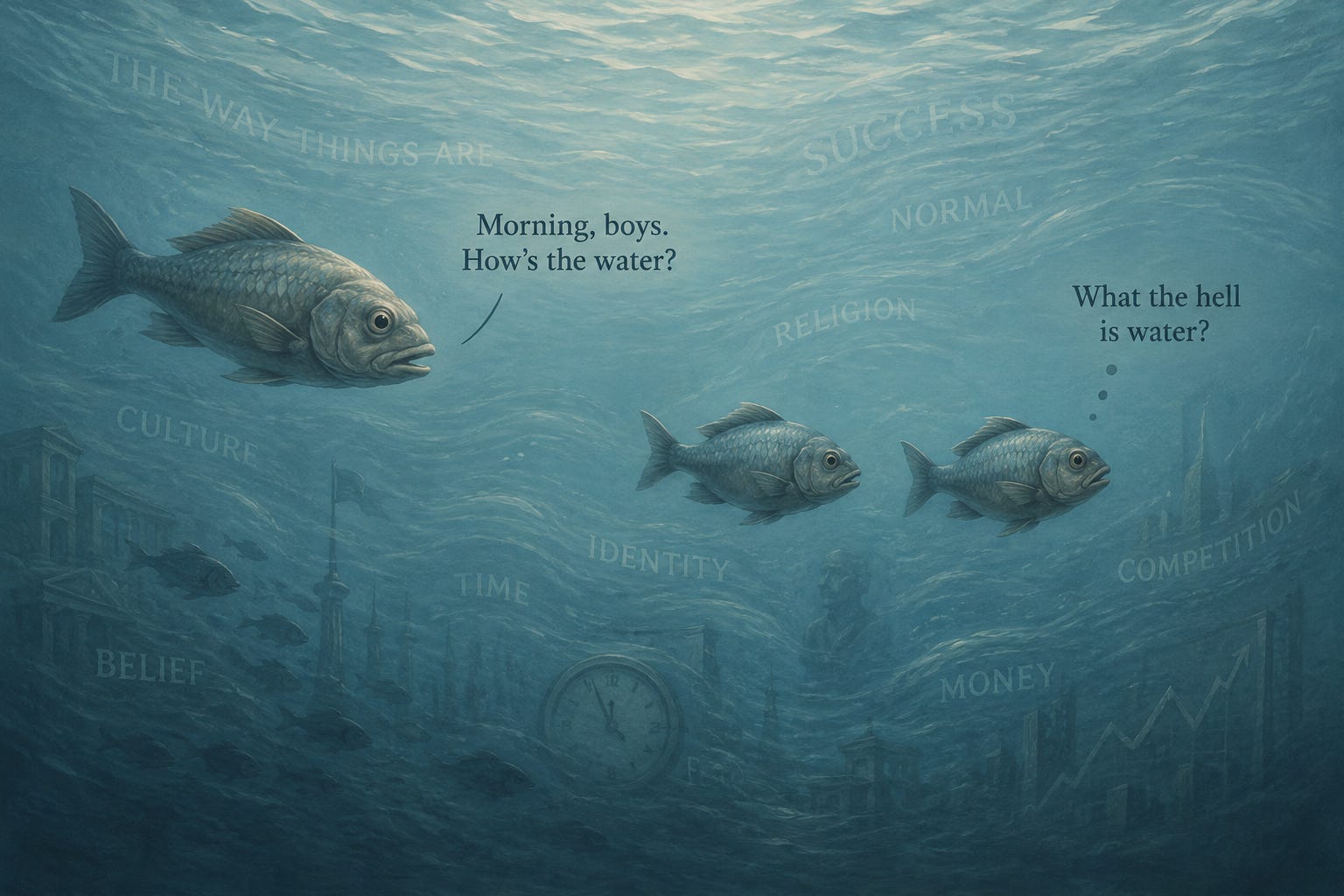
It is what it is.
This is how we’ve always done it.
Most of the times, it’s not even as explicit as that. Our lives take place within social constructs, parameters and rules that we take for granted – until something happens to shake them up.
If the fish in the parable were to suddenly be yanked onto dry land, they’d immediately realise what water is.
But not all waters are good for all fish.
Some fish need freshwater, others seawater. Some are too massive to live in anything else but an ocean. Some are amphibious.
None of them should ever live in polluted waters.
But they do, just as we do.
The world we live in is not one that has been designed for all people. It is instead one that has been shaped by the preferences of the powerful, whoever they happened to be at a particular time or place. Patriarchal, colonial, capitalist, ableist, sexist, racist etc. forces have built and destroyed, elevated and suppressed, amplified and silenced aspects of the waters we swim in, however it best served those who had the formal and informal decision-making power. Worldviews and very real world structures have been disproportionately shaped by the will and whims of a minority of the human population.
As time went on, we were all forced, in overt or insidious ways, to accept the world that resulted as the only world that is possible. And to adopt what this world regards as worthy as the standard we should all aspire to.
It is what it is.
This is how we’ve always done it.
The concepts of work, career and meaningful contribution have not escaped this influence.
“Everybody is a genius. But if you judge a fish by its ability to climb a tree, it will live its whole life believing that it is stupid.” (often attributed to Albert Einstein but actually author unknown; while we’re on Einstein)
I was talking with a friend the other day who shared that she is not sure whether she is a philosopher, because her way of approaching philosophy is different from those of philosophy graduates she’s met; while they’re very intent on drilling into the precise meaning of a micro-detail in philosophy texts, she’s much more of a generalist and pragmatic in her approach to philosophical ideas.
My reply to this was (long, but at its core): maybe you’re a type of philosopher we haven’t seen yet. You need to remember that philosophy has been overwhelmingly shaped by men. Perhaps what you bring here is a more feminine approach to philosophy.
Now of course, that answer is structured by a framework of archetypal masculine/feminine polarity, which is a complex topic beyond the purposes of this article. It is however important to note that I don’t subscribe to anti-trans or trad wife bullshit.
And while this feminine/masculine framing does work to structure my own thinking, it is simply the water I swim in, and it doesn’t have to be the water that you swim in.
My point is that if you’re a minority (and I count women as minorities for the purposes of this conversation), and you feel that vocation-wise you can’t quite find your place in the world, the issue could be that you’re trying to fit into structures that were never designed for you.
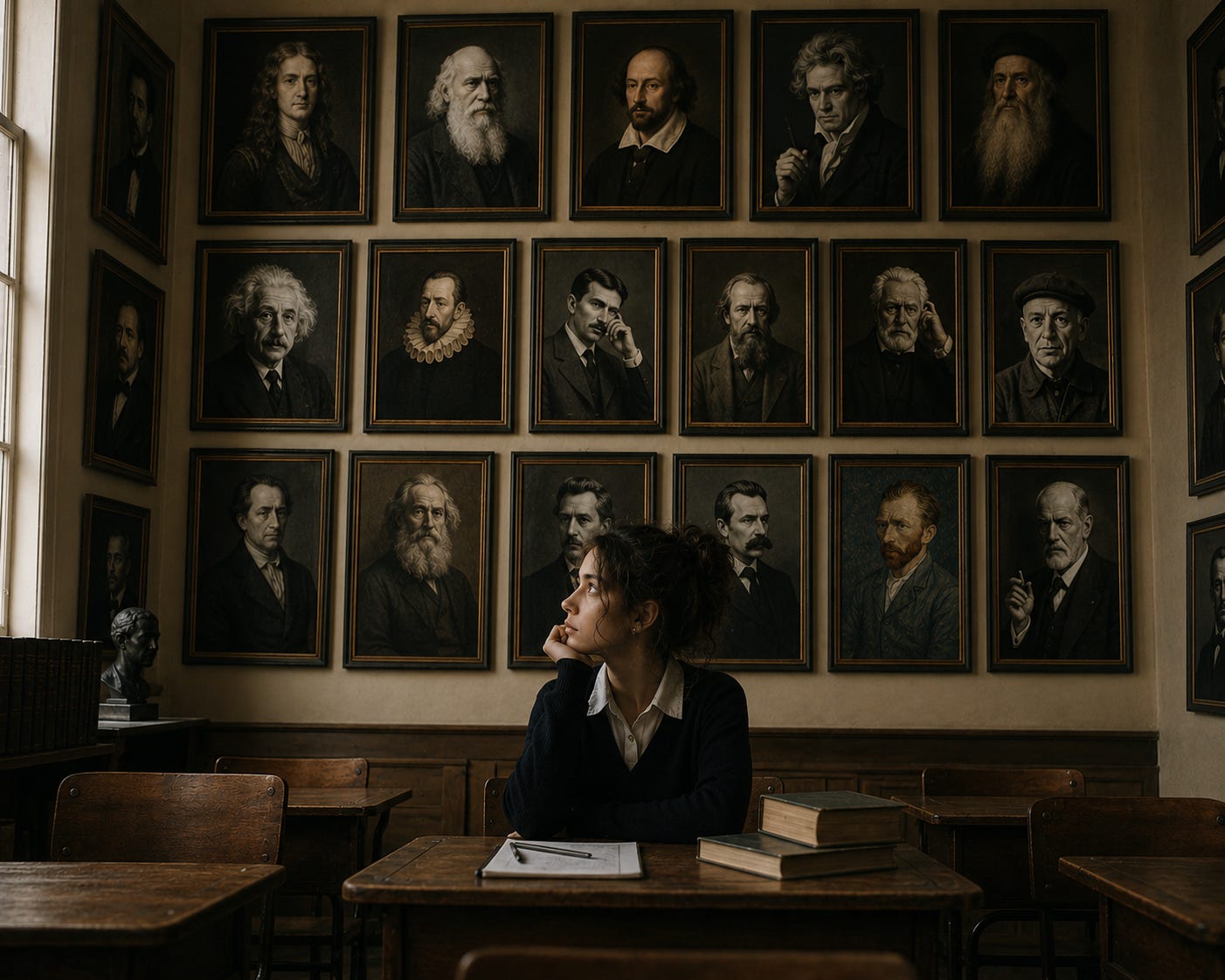
And when that’s the case, the only thing that we are left with is to design our own structures, to create the space in the world for our talents, to demand it.
While this necessitates collective and systemic change, there are things we can do at an individual level to start to free ourselves from the shackles of paradigms that stifle our potential.
For my own vocation as an astrologer, it was absolutely necessary for me to change my paradigm from scientific materialism (which posits that all that exists are matter and its physical processes, and thus symbols and archetypes cannot be meaningful aspects of reality) to post-materialism and specifically a consciousness-first worldview, in which consciousness itself is a fundamental ‘material’ of reality and as such, opens the possibility that symbols and archetypes can be meaningful.
Without this, it would have been virtually impossible for me to become an astrologer.
Even if I were to feel drawn to it (which I was as a child/teenager, as I was regularly following horoscopes), my mind wouldn’t have let me anywhere near it, because of two interconnected reasons:
the attachment to being seen as a ‘smart person’
the belief that being a smart person means being a ‘science’-y person
So obviously, when everything around me told me that astrology was a pseudoscience, I wouldn’t touch it, because touching it would cause an identity-level crisis; i.e. what if I’m actually not a smart person?
It took many years of self-worth work (i.e. finding validation within myself as opposed to seeking it from other people), 6 years of specifically looking at the intersections of science and spirituality, and also having my birth chart read – and seeing that it really does reflect real themes in my life – in order to consider a course of action I never would have before:
Studying astrology.
At first for fun, but also to gather more evidence.
I was mentored by a professional astrologer with 20+ years of experience. After our first round of mentorship, she said I had a knack for it. I felt it too.
By now, enough things had shifted for another idea to enter my mind: could this actually be the work I’m meant to do?
I knew that deciding to be an astrologer would inevitably raise some eyebrows, especially coming from a scientific/research background! But all the years of personal development + exploring science and spirituality were finally paying off: I had built myself a very solid foundation which could now withstand the inevitable skepticism or mocking:
I reached a point where my own validation of my smarts was more valuable than that of other people’s
I abandoned the belief that the only smart people are ‘science’-y people
I knew enough feminist theory to know that women’s ways of being and thinking have been devalued for thousands of years, which made me wonder if that’s what I might be experiencing too
I saw enough scientific evidence of the reality of parapsychological (psi) phenomena to make me believe there is more weirdness to reality than scientific materialism can explain: “The evidence for psi is comparable to that for established phenomena in psychology and other disciplines, although there is no consensual understanding of them.” (Cardeña, 2018)
I needed the validation of scientific evidence to show me that I was not crazy for having ‘paranormal’ experiences and seeing validity in practices like astrology.
But once I felt solid that there’s enough scientific evidence out there that supports or at least allows for the reality of my extraordinary experiences, I could now leave behind the need for scientific validation at each step, and put more trust in my own experiences, perceptions and pattern-recognition.
I could now trust the evidence of my own eyes and senses.
For groups that have been historically oppressed, this in itself is a revolutionary act: it centers our experience in a world that has consistently pushed it to the sidelines.
Something I wrote a few years back is fitting here:
One thing we’ve been fighting for as women is the right to define our world.
To define the rules of the game. To define “how things are”, and not simply bend to it. Furthermore, to reserve the right that “how things are”, our ways of being in the world, can be radically different from those of other women – real or “oughted to”.
So it’s not “worthful women” that I’m speaking for here -- it’s just one woman, me, myself that I have the expertise for and authority to put out there in the world. (or to not put out there in the world -- my being-ness also exists in the hidden, the only witnessed by me, and that is enough, that doesn’t make it any less worthy.)
I am the observer, judge, jury and executioner of all paradigms that don’t work for me.
This is the right that as a woman, seems radical.
We’ll continue this topic in the next article with the examples of two scientists, both women, who were seen as weird and told their approaches were wrong, but ended up revolutionising their fields because they dared to be a type of scientist that no one had seen yet.
🌱
If something in this resonated, a vocational astrology reading might be your next step.
Many of us are feeling the call to bring a new type of contribution to the world, one that feels truer to who we are, yet may look very different to what we’ve done before, or what we’ve been taught is ‘sensible’, ‘allowed’ or ‘worthwhile’.
Through my vocational astrology readings, I can help amplify the volume of that call so that you can hear it clearly and act on it with confidence.
£77 • 60 minutes • recording included • book here
Until next time,
Cristina